The History & heritage Trail

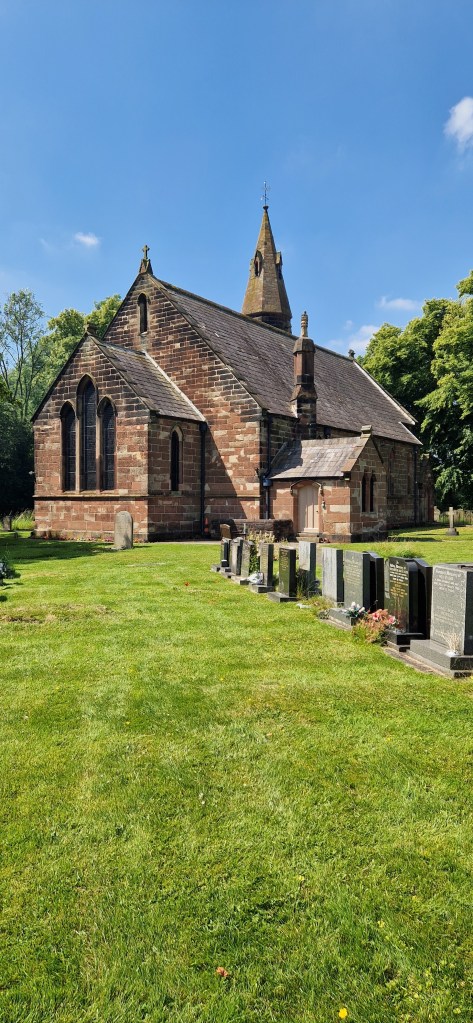
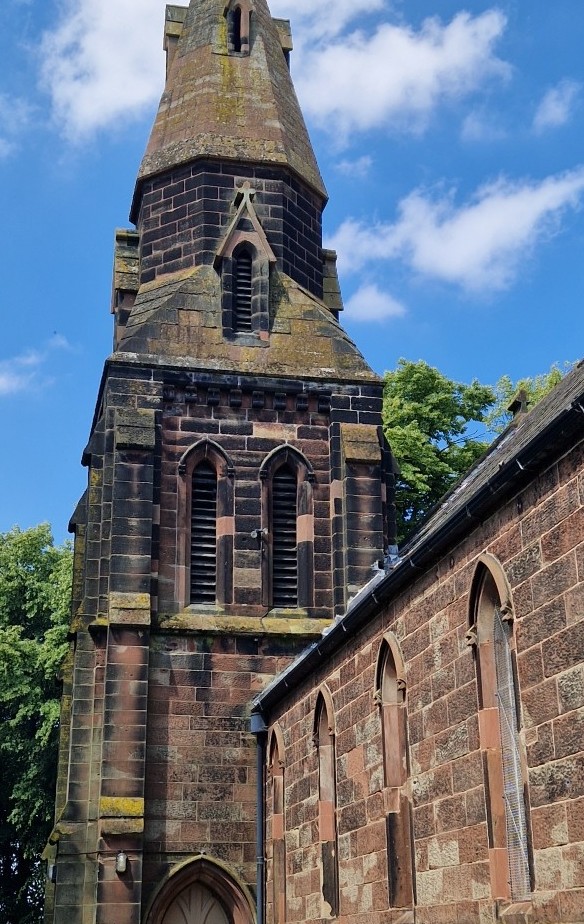
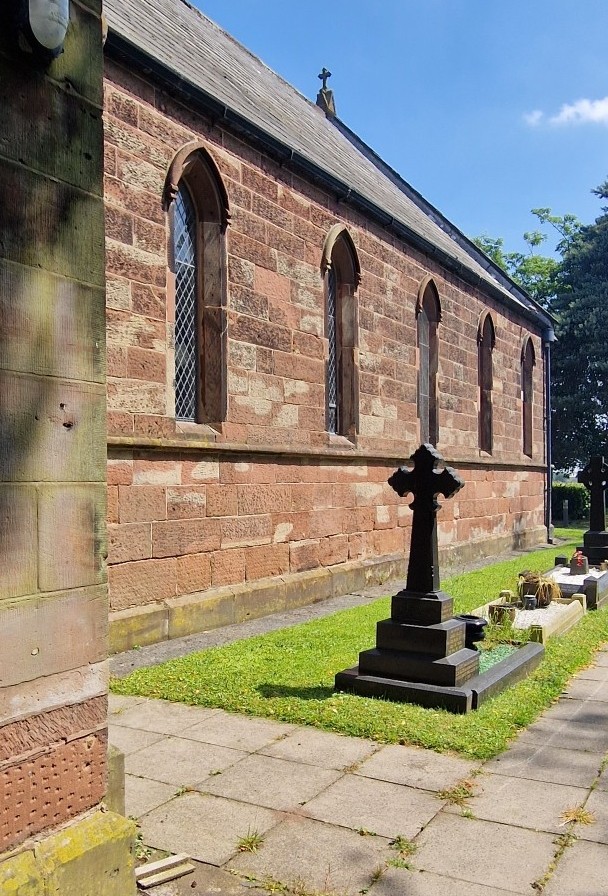
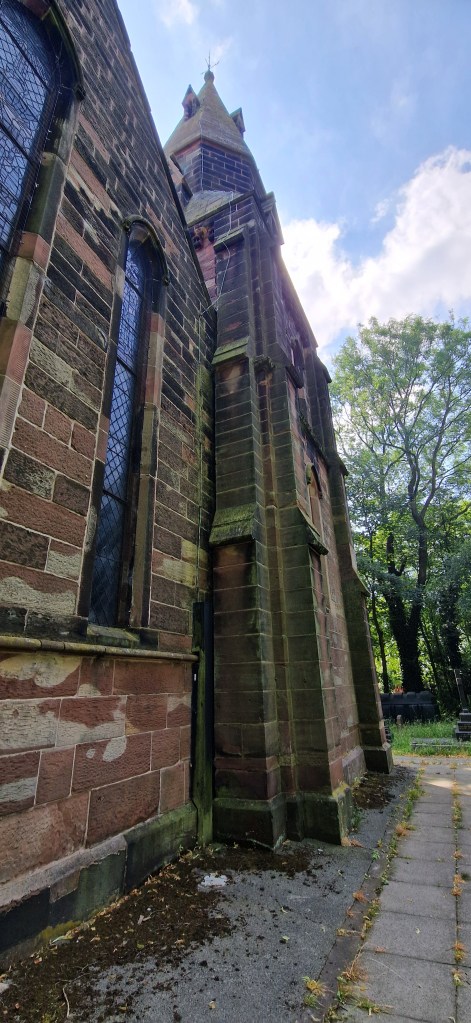
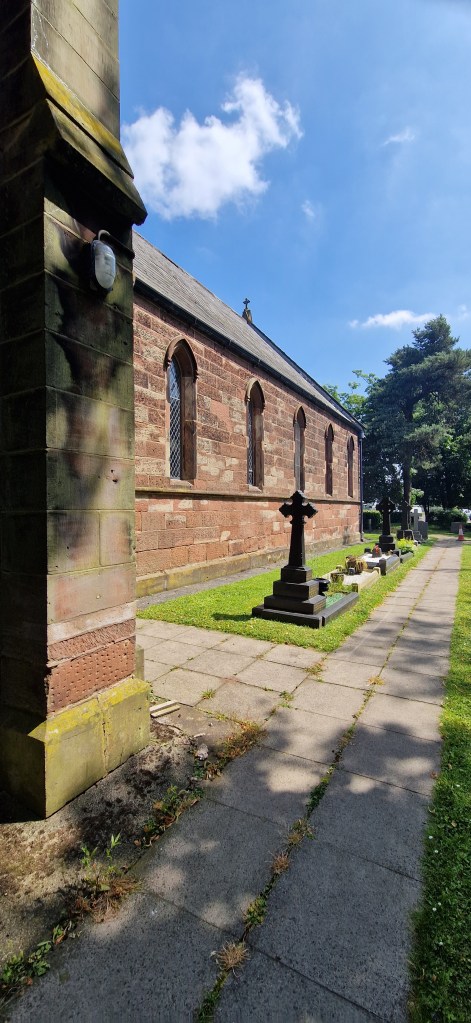
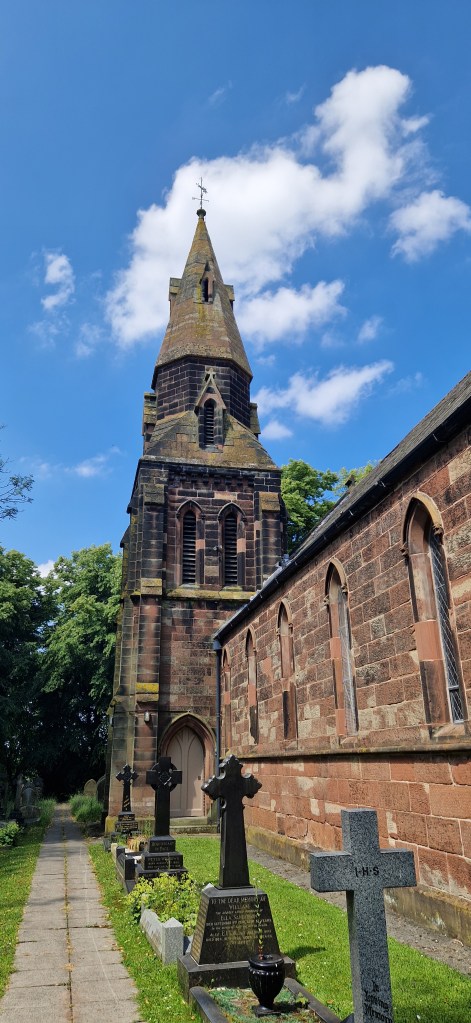
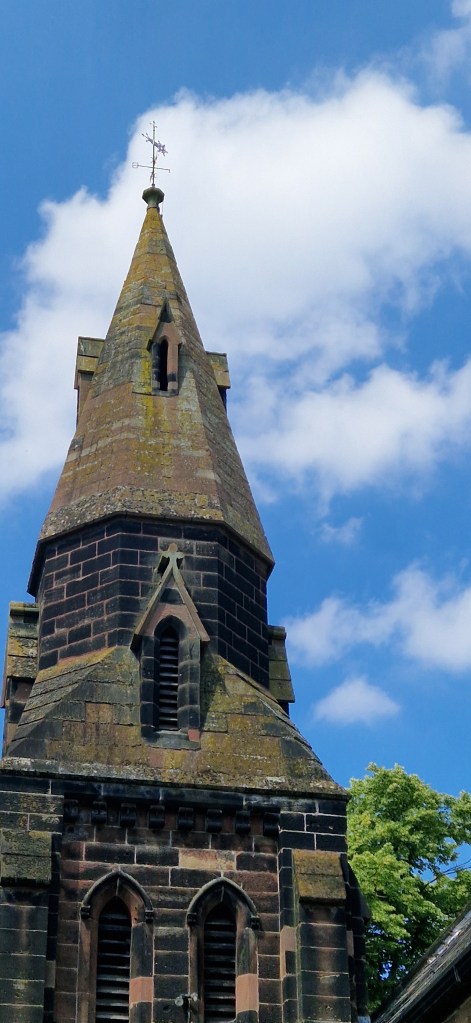
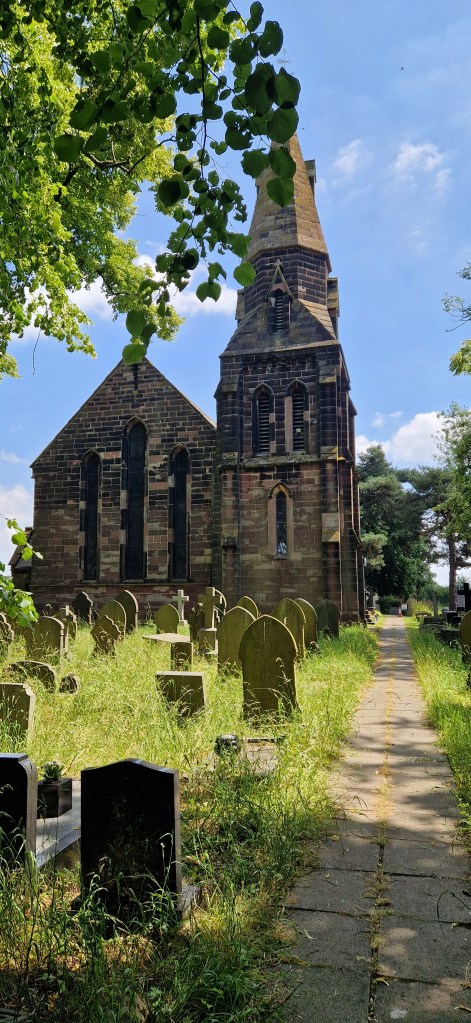
Initial write up from lan-opc.org/Winwick/croft/christchurch.html Built as a chapel of ease to the Mother Church of Winwick in 1832-1833, Christ Church Croft occupies a prominent position in what is probably one of the highest parts of the village. The Church is of Gothic design with a spire designed by one of the foremost architects of the day, E. Blore, Esq., and built by James Pierpoint at a cost of £2667.00, of which the Parliamentary grant provided £1457, the remainder being raised locally. Mr. Samuel Barrow gave the land for the Church & Churchyard; the Church was consecrated by the Bishop of Chester (in whose diocese Croft then was) on 29th November 1833. The present site was chosen as being a mid-point between Croft and Risley who’s two communities it was built to serve. The sandstone for the building was transported by the Croft farming community from Delph Lane.
In the Churchyard by the North gate stand two stone pillars which were once the sides of the Croft stocks.
Croft was separated from Winwick as a parish in the year 1845, then having a rateable value of £276. The seating capacity was 518, made up of 226 in paid pews and 292 free. In 1904 the old high-backed pews on the North and the South sides of the Church were replaced by the present Oak pews. The stone flagged floor was also replaced by the present wood block one. A new heating apparatus with pipes and radiators round the walls was introduced at the same time; this was replaced in 1957 by off-peak electrical system. In the year 1999-2000, when the Church was totally refurbished a new oil fired heating system was installed.
Windows
Mayhr & Co of Munich made the East window. It is a three light window, representing the Good Shepherd with St. Peter & St. Paul on the left and the right. The family of the Rev. T. P. Kirkman gave the central light in his memory; the other two flanking windows were given by the friends and parishioners of Croft in memory of the Rev. T.P. Kirkman & Mrs. Kirkman. The windows on the North & South side of the Chancel, representing St. John & St. James were given by Mrs. P. Ingham in memory of her parents. Messer’s Shrigley & Hunt of Lancaster made the remaining windows. The central light at the West end which depicts St. Cecilia was given by the parishioners of Croft in memory of Mr. T. Hurdus, who died in 1948 having been the organist for 44 years. Mr. & Mrs. Peter Ingham gave the two flanking Angels respectively. Below the gallery at the West end is a window by Shrigley & Hunt of Lancaster, given by the Sunday school children in 1954.The first window on the North side depicting Christ with the children of the world commemorates the service of Mr. & Mrs. Ingham to missionary work and also to the fact that Mr. Ingham served as a Churchwarden & Sides man for 50 years, both were Sunday school teachers. The second window on the North side commemorates Mr. C. S. Smith of Heath House, Croft for many years a worshiper in the Church. The South window is in memory of Mr. and Mrs. A Stout who had been members of the Church for over 40 years.
Gifts & Memorials
The plaque on the North wall commemorates the use of the Church by H.M.S Gosling during the Second World War. British Coal presented the plaque on the South wall to the Church when they vacated their offices at Anderton House (a former H.M.S Gosling camp). The Royal Navy gave a Chalice & Paten to the Parish when the camps closed. The framed picture on the North wall was given by the executors of Miss. M. Marsh of Peak House, Croft in her memory. On the South wall a war memorial tablet records the names of twenty men from the Parish who died in the First World War and three who died in the Second. The Eagle Lectern was given by the family of Drummer Edgar Clough killed in action in Mesopotamia on the 8th March 1916. The Reredos in coloured marble and Caen stone together with the oak panelling on the East wall of the Chancel were given by the Rev. H. I. Wadeson in memory of his wife, whilst the panelling on the North and South walls of the Chancel were given by the parishioners in memory of Mrs. Wadeson. The Communion Table, chairs and pulpit handrail were the Parish’s memorial to the Rev. H. I. Wadeson. The marble steps in the Chancel were the Parish’s memorial to the Rev. S. Barrow who’s daughter gave the Altar Cross in memory of Mr. & Mrs. Cawthorne, Mr. Cawthorne was the Schoolmaster in Croft from 1891–1917. The Font cover at the West end of the Church was given by the soldiers of the Parish as a Thanksgiving of their safe return from the First World War. The book of remembrance which is also at the West end of the Church records the names of those whose ashes have been interred in the Garden of Remembrance was given by Mrs. P. Hopley in memory of her husband Alfred Thomas Hopley who had been a Sides man and P.P.C. Secretary for many years. The oak shelf and book rest on which the Book of Remembrance stands were given by Mrs. Moore in memory of her late husband, Thomas Moore who was Rectors Warden 1950-1960.
The Litany desk was given by Miss. Withington in memory of her late father Captain E. Withington J.P of Culcheth Hall who worshiped here for many years.
The suspended Cross in the Church is the memorial to Canon H.A.C Hughes, Rector of Croft 1944 – 1970.
The brass tablet on the organ commemorates the life of Mr. C. H. Ingham who was the organist at Croft Church for many years.
The leather bound Church Lessons Bible and the leather bound New English Bible were presented to the Church by Mr. & Mrs P. Ingham and Mr. & Mrs. S. Jones respectively.
A stainless steel Flagon commemorates the memory of Rev. John Taylor, Rector of Croft 1975–1978.
Restoration
The Church spire was overhauled in July 1910, the decayed stonework being renewed, the cracks made good with mastic cement down to the square, total for the same being £25 which included making safe the lightning conductor.
Mr. Silas Clough provided a notice board fixed near the North door of the Church to replace the old one.
In the years 1962-1963 a much needed general restoration of the exterior fabric of the Church was undertaken. New drains were inserted at the base of the foundations of the North wall to try to eliminate the constant dampness. The interior walls were re-plastered where necessary and the whole interior of the Church re-decorated. The lighting system was tested and where necessary renewed. The total cost of this work was £3750.
Incumbents
The first Curate at Christ Church Croft was Benjamin Banning whose Curacy lasted from 1833 to 1838. He left Croft to become Curate at St. John’s Liverpool staying until 1841. He was appointed Vicar of Wellington, Salop in 1841 and he remained in that post until 1881.
Thomas Penyngton Kirkman a distinguished mathematician and a Fellow of the Royal Society was Curate from 1839 until 1844, when he became the first Rector of Croft he held that position until 1892 when Henry Isaac Wadeson took over, during his Incumbency of 41 years every part of the Church with the exception of the stone walls was renewed, much of the beautiful decoration of the Church and Organ was the work of his own hands. In his early days Mr. Wadeson took an active interest in sport; walking, wrestling and boxing being amongst his accomplishments. He was fond of cycling and a great lover of nature particularly birdlife. An eloquent and gifted speaker, he was much in demand for Harvest Festivals in neighbouring villages and towns. He was of powerful build and until a few days before his death on 17th March 1933 enjoyed robust health. Mr. Wadeson is buried in the Churchyard.
From 1933 the Rector was Samuel Barrow; during his short time as Rector he devoted much of his energy into raising a memorial to his predecessor. He was an Evangelical Churchman of considerable musical ability and in keeping with the traditions of the Church ensured his services were as bright and beautiful as possible. He died on the 4th of January 1936 and is buried in the Churchyard.
From 1936 the Rector was William Chadwick, during his incumbency the Abdication crisis of 1936 and the Coronation celebrations of the following year took place. He was Rector for most of the Second World War and as such saw many of his congregation leave for active service. He resigned in 1944 and moved to London joining his son who was Vicar of Crouch End.
From 1944 the Rector was Herbert Alexander Carlyle Hughes L.LB. During his 26 years as Rector saw the former Memorial Institute replaced by the present Memorial Hall playing an active part in bringing this about. He was appointed Rural Dean of Warrington in 1957, he held this position until his death on the 4th June 1970 and he was buried with his wife in the Churchyard of All Saints Rainford.
John Alexander Woolley was the Rector from 1971 until 1975 when he resigned to become the Chaplain of Ryhope Hospitals in Sunderland.
John Taylor became the Rector in 1975 and remained until his death on the 12th September 1978. He his buried in the Churchyard at Christ Church Croft.
From 1979 the Rector was Richard H.L. Williams who remained as Rector until his move to Wavertree, Liverpool in 1989.
Peter Thorn became the Priest-in-charge in 1990 until 1992 when he left to take up a position in the South of England.
From November 1992 the Priest-in-charge was Wilfred Alexander who elected in 1999 to become the Assistant Priest-in-charge at Croft and Newchurch. The Rev. Alan Litton Rector of Newchurch filled the position of Priest-in-charge at Croft. The Rev. A Litton resigned from the joint benefice of Croft and Newchurch on the 6th October 2002.
On the 6th July 2003 the Rev. Dr. Christopher Stafford was appointed as Rector, he was formerly Curate of St. Philip’s, Westbrook who had studied at University at the age of 18 to obtain a degree in plant biology going on to obtain a PhD in Cell biology. In 1991 he spent a year with Birmingham City Mission working with homeless people, later working with the victim support department at Birmingham Crown Court, Afterwards studying for Ordination to the Priesthood and was ordained Priest in Liverpool Cathedral on 18th June 2000, becoming Curate of St. Philip’s, Westbrook until his appointment to the joint Benefice of Newchurch and Christ Church Croft.
NB:
The above history of the Church was written by Mr. Peter Ingham in 1934. Mr Ingham was a Churchwarden for some 50 years and was the father of Mr. Clifford Ingham, one time organist at the church; his brother was Mr. Ralph Ingham who was my grandfather.
Heritage Trail
On entering the church by the North door admittance is gained to the inner north vestibule, and passing through this entrance is gained to the Church. On the North and South vestibules, are the following inscriptions.
South Side: TO THE GLORY OF GOD AND IN MEMORY OF JOHN BELLAMY OF CROFT.
North Side: THIS SCREEN WAS ERECTED BY HIS WIFE AND GRANDDAUGHTER 1896.
At the foot of the font is a brass ewer given to commemorate the Baptism of Clifford H. Ingham, in 1905
Continuing up the centre aisle, we pass between two wooden screens, which once formed one whole Chancel screen, and are inscribed as follows:
South Side: TO THE GLORY OF GOD AND IN LOVING MEMORY OF ADA SMITH 1867-1939.
North Side: IS GIVEN BY HER BROTHER CHARLES STANLEY SMITH AND HIS DAUGHTER NANCY 1940. As we walk towards the East end of the church, to our left on the North wall is a plaque with the mounted crest of H.M.S. Gosling, which bears the inscription: PRESENTED TO CROFT PARISH CHURCH BY THE OFFICERS AND MEN OF H.M.S. GOSLING WHO WORSHIPPED HERE 1942-1947. (H.M.S. Gosling camp1 stood on the site of Wadeson Way, Churchfields, Eaves Brow Road, Chadwick Avenue and Pasture Drive)
Also on the North wall are two windows, the first one bearing the inscription TO THE GLORY OF GOD AND IN MEMORY OF CHARLES STANLEY SMITH BORN 1869 DIED 1957 AGED 87 YEARS ERECTED BY HIS SON AND DAUGHTER.
The second window bears the inscription IN MEMORY OF PETER INGHAM SIDESMAN AND CHURCHWARDEN FOR 50 YEARS AND OF EMMA HIS WIFE WHOSE LIFE WAS DEVOTED TO FOREIGN MISSIONS.
On our left as we pass into the Chancel is the Choir Vestry Screen which bears the inscription TO THE GLORY OF ALMIGHTY GOD THIS SCREEN WAS ERECTED BY THE EFFORTS OF Mr. SILAS CLOUGH-CHRISTMAS 1905.
On the North wall of the Chancel is a brass tablet which reads as follows TO THE GLORY OF GOD AND THE MEMORY OF MARY WADESON WIFE OF THE RECTOR OF THIS PARISH WHO ENTERED INTO REST 10 JULY 1911 THE NORTH AND SOUTH WALLS OF THIS CHURCH WERE PANELLED AND THESE ALTAR RAILS WERE ERECTED BY THE PARISHIONERS OF CROFT.
Also, on the North wall is a brass tablet bearing the inscription THESE MARBLE STEPS ARE ERECTED TO THE GLORY OF GOD AND IN MEMORY OF SAMUEL BARROW M.A. RECTOR OF THIS PARISH 1933-1936.
The two single light windows on the North and South walls of the Chancel, depicting St. John and St. James bear the inscription TO THE GLORY OF GOD AND IN MEMORY OF JAMES HARDIKER OF BOLTON AND MARY HARDIKER OF BOLTON ERECTED BY THEIR DAUGHTER 1912 (their daughter was Emma Ingham)
The East windo depicting Our Saviour as the good shepherd and flanked by two single light windows depicting St. Peter and St. Paul bear the inscription IN MEMORY OF THE REV. THOMAS PENNINGTON KIRKMAN M.A. FRS. FOR 52 YEARS RECTOR OF THIS PARISH AND OF ELIZA ANNE HIS WIFE< ERECTED BY MEMBERS OF HIS FAMILY AND THE PARISHIONERS OF CROFT 1896. He was a distinguished mathematician and a Fellow of the Royal Society.
On either side of the East window are two panels, which have painted on them, The Apostles Creed, The Lords Prayer, and the Ten Commandments. This work was carried out about 1914 by Messrs. Dell of Warrington and the cost was met by the following persons: Mr. S. Clough 25 Shillings; Mr. Peter Collier, 21 Shillings: Mr. Stanley Smith, 10 Shillings & 6 Pence; Mr. Hodgson, 21 Shillings; and the Rector. The whole operation was brought about by the efforts of Mr. Silas Clough (who also presented the lectern) the Apostles Creed does contain a spelling mistake? Will you be able to spot it?
Below the East window is the Reredos of Caen Stone and bearing a Marble tablet with the inscription TO THE GLORY OF GOD AND IN LOVING MEMORY OF MARY WADESON WHO ENTERED INTO REST 10 JULY 1911 THIS REREDOS IS ERECTED BY HER HUSBAND THE RECTOR OF THIS PARISH.
The brass cross which it stands on the Communion table bears the inscription TO THE GLORY OF GOD AND IN MEMORY OF JAMES CAWTHORNE HEADMASTER OF CROFT SCHOOL, 1891-1927 AND ANNETTE CAWTHORNE PRESENTED BY THEIR DAUGHTER.
The South wall of the Chancel carries a brass tablet with the following inscription IN AFFECTIONATE MEMORY OF HENRY ISAAC WADESON RECTOR OF THIS PARISH 1892-1933 ENTERED INTO REST 17 MARCH 1933 THE HOLY TABLE, CHAIRS AND PULPIT HANDRAIL WERE GIVEN BY FRIENDS AND PARISHONERS OF CROFT – THE MEMORY OF THE JUST IS BLESSED.
Also, on the South wall of the Chancel is a brass tablet with the inscription TO THE GLORY OF GOD THE SUSPENDED CROSS IN THE CHURCH IS THE MEMORIAL TO CANON H.A.C. HUGHES LLB FAITHFUL RECTOR OF CROFT FROM 1944-1970. BENEATH THE CROSS OF JESUS.
Turning and walking towards the West end of the church, on our left is the Eagle Lectern which carries on a brass Tablet, the following inscription, TO THE GLORY OF GOD AND IN MEMORY OF DRUMMER EDGAR CLOUGH 1ST MANCHESTER REGIMENT WHO FELL IN ACTION IN MESOPOTAMIA 8 MARCH 1916 AGED 21. THIS LECTERN IS PRESENTED BY HIS PARENTS AND SISTER, SILAS, MARIA AND EDITH CLOUGH.
On the South wall is a single light window bearing the inscription, IN MEMORY OF ALBERT AND BEATRICE STOUT, MEMBERS OF THIS CHURCH FOR OVER FORTY YEARS.
The plaque on the South wall bearing the crest of H.M.S. Gosling was given by the National Coal Board when their offices at Anderton House, Lowton were vacated, (they stood on the site of one of the Gosling camps.
Further along on the South wall is a Marble tablet, which bears the names of those who fell in the great War of 1914-1918 and also of those who fell in the second World War of 1939-1945. (note. The first name on both tablets is James Wood!!)
Looking up towards the gallery, the central light depicting St. Cecilia was given by the parishioners in memory of Mr. T. Hurdus, who died in 1948, having been Organist for 44 years. The two flanking single lights were given by Mr. and Mrs. P. Ingham.
The small window behind the font was worked for and given by the Sunday school from monies raised from the staging of pantomimes.
This then concludes the short historical passage through the interior of the church and the main fixtures, as it were.
There are of course, other times of interest, which would be somewhat imprudent to have on permanent display. One time which does however have a connection with the more recent past, is displayed in the vestry, and is in the form of some pieces of shrapnel which fell within the church boundaries, during an air-raid in World War 2 and were collected by Canon Hughes and saved for posterity.
Christ Church Croft-Churchyard History Trail

Begin at the rear of the church under the East window. There you will see inscribed on the stonework, the date 1833. This is the date the church was built, 191 years ago (as of 2024)

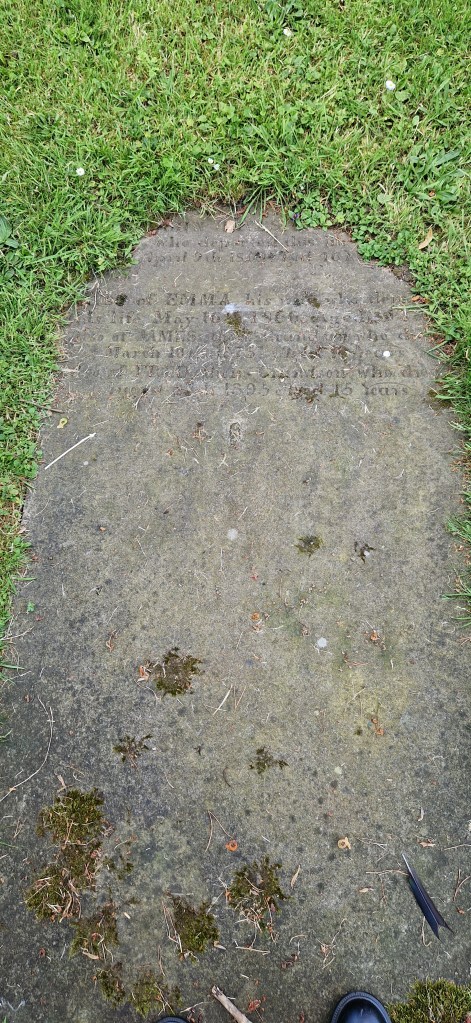
Walk along the path towards the Garden of Remembrance and if you look to your left as you pass the first line of graves you will see, about Three or Four rows down, a grave with a broken tablet on top of it (see above). This is the resting place of George Newbrook (Sammy Buttercup). who wrote poems in the Lancashire dialect. The inscription on the tablet, although now virtually unreadable, goes as follows
‘Grief to our coffin adds a nail, no doubt,
Whilst every grin so merrily pulls one out‘
Walk to the end of the path and turn left, before taking the turning to walk back towards the church, notice the grave on your left (see above) of the Rev. Canon H.A.C. Hughes, who was Rector from 1944 until 1970. He worked tirelessly for the good of the village, and played no small part in ensuring that the Memorial Hall in Mustard Lane was built.

As you walk along the path, notice on your right, the remains of the Croft Stocks, and a one-time popular method of punishment. (At least for the on lookers) Of all the interesting features of this church, inside and out, the pillars of the Croft Stocks are my favourite. They are in the Churchyard by the North gate.
The stocks were the best known of the old instruments of punishment. They common form of stocks consisted of two posts of stone standing some yard and a half apart and having a groove or slot cut into the inward face. Into these grooves were held a pair of thick boards standing on edge, the one on top of the other. The lower board was fixed. While the upper board could slide up and down in the grooves, or be fastened down with a padlock. Two round holes were cut into the boards, half in the upper and half in the lower board, so that when a man’s or woman’s ankles were fastened between them he or she would be unable to withdraw his or her feet. A seat was provided upon which the prisoner sat with his or her feet stuck out straight in front.
The purposes for which the stocks were used were of two kinds. Firstly, for those offenders for whom the punishment was prescribed in the statutes, the chief of whom were runaway labourers, vagabonds, drunkards and sabbath breakers. Secondly, the stocks always being at hand and applicable with little trouble and expense, they were frequently used as a milder alternative than the fine or imprisonment which was the legal due of any minor offender. The stocks therefore became an instrument of manorial discipline of the most effective kind even when this was not the original object of their erection.
The Warrington stocks were situated at Bridge Foot at the beginning of the nineteenth century. At some former period, the stocks must have been portable by being placed on wheels, similar to the Latchford stocks preserved in the Warrington Museum, which gave the added advantage that they could be set up for action in any position.
On one occasion a comrade of a prisoner got the stocks loose and drew them and the incarcerated prisoner through the town and had a jovial day’s fun, frolic and drinking. (Warrington Guardian 4th May 1861)
The ‘Constables’ were responsible for the administration of the statute of 1606 which referred to drunkenness: ‘An act for repressing the odious and loathsome sin of drunkenness’. By this act, the constables had to inquire of drunkards and present them to the Court Leet (a local criminal court for the punishment of small offences).
They were to be fined 5s for every time they were drunk ‘to the use of the poore of the parish’ where the offence was committed, or if not able to pay then after conviction to sit six hours in the stocks.
Eavesdropping was also punishable by a fine or the stocks.
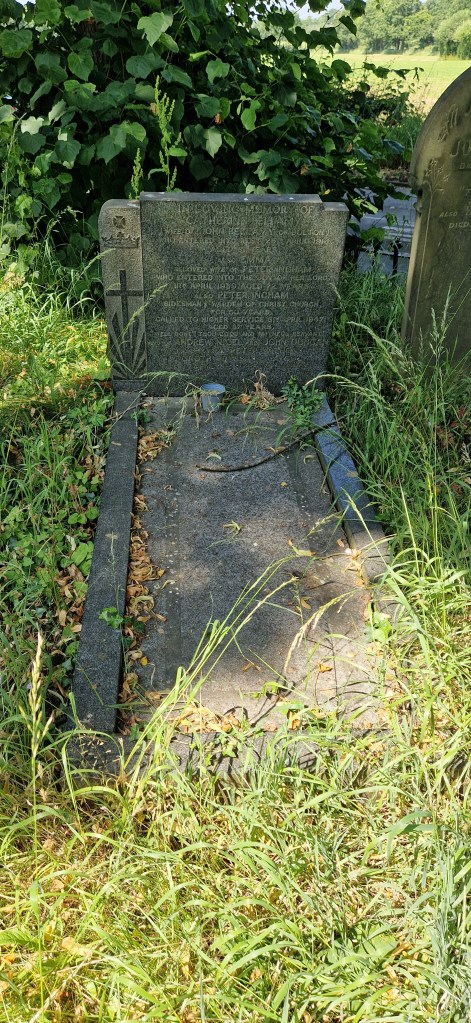
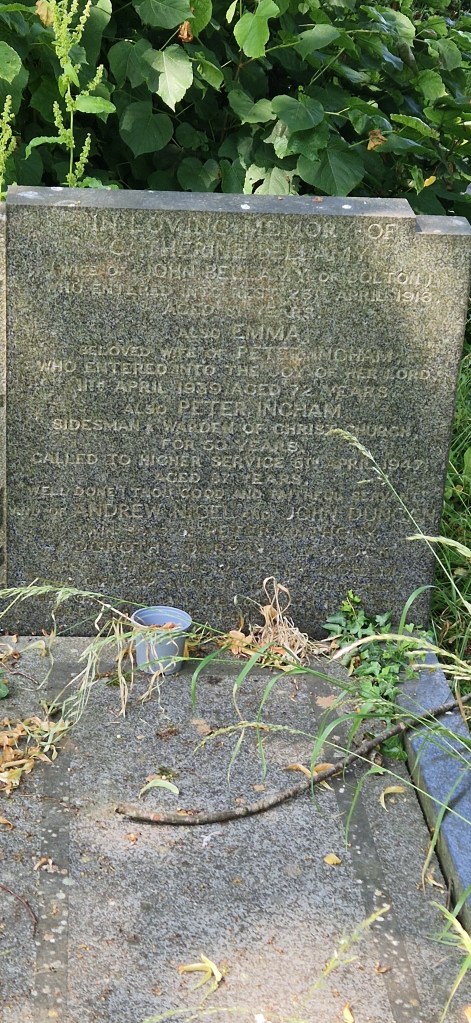
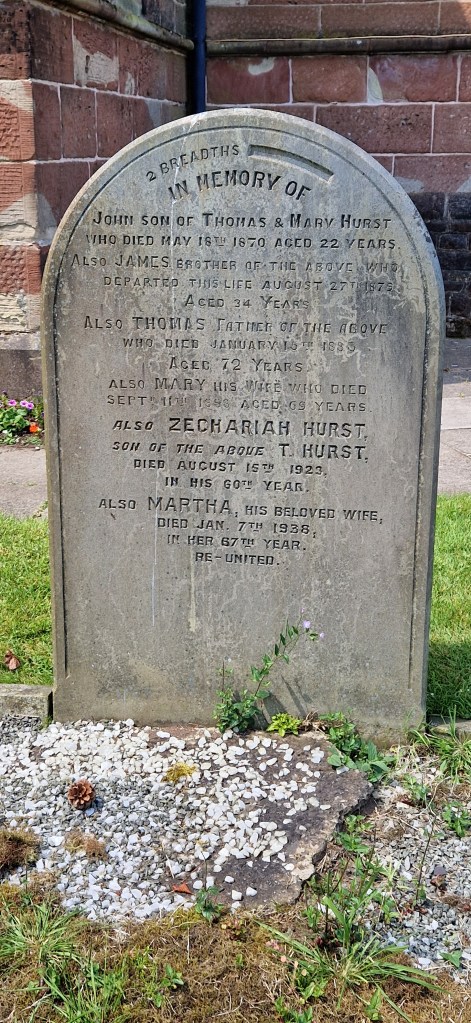
Continue walking towards the church and go round to the West side of the church, before passing the base of the steeple, look to your right, and on the last graves, bordering Lady Lane is the grave of Peter Ingham, who was a Sidesman and churchwarden for 50 years.
Passing the base the base of the steeple turn right, towards Lady Lane, at the fourth row of graves on the right, about two graves from the path, notice the grave of the Rev. T. P. Kirkman, who was Curate, and then Rector of this Church from 1839. He was a distinguished Mathematician and a Fellow of the Royal Society. (No Picture as I missed this one)
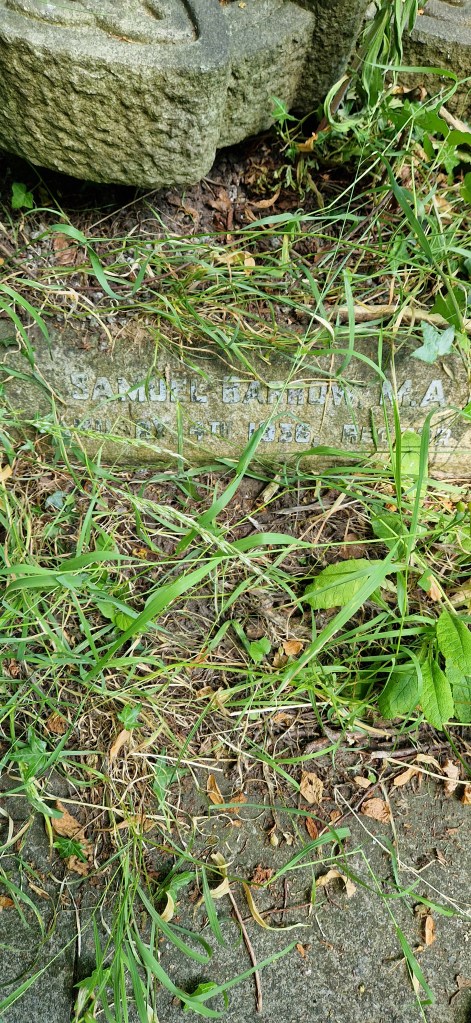
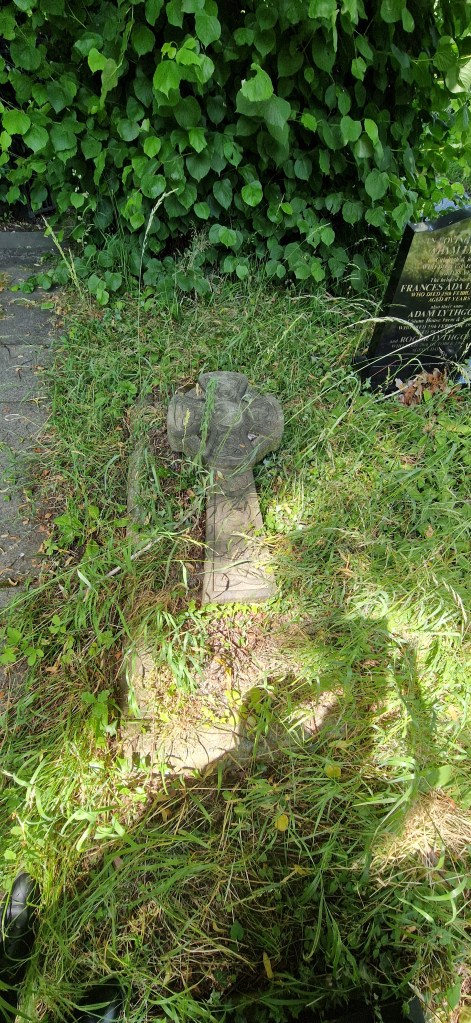
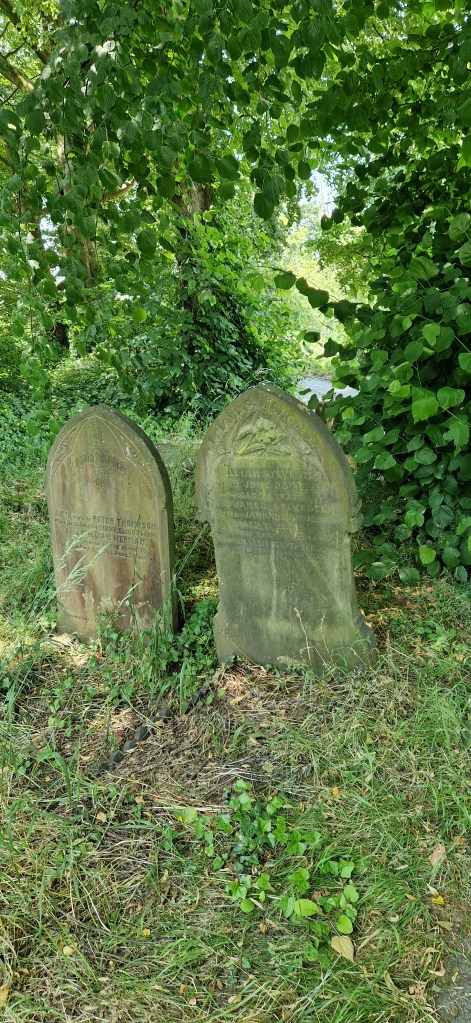
Continuing along the path to the South gate, notice the last grave on the right of the Rev. S. Barrow, who was Rector from 1933 until 1936. (See above)
Across the path, near to the boundary wall, are two white marble tablets, which were formerly in the graveyard of the now demolished, Croft Unitarian Chapel at the end of Lady Lane. Although now somewhat overgrown, they were placed there when the chapel was demolished in the 1960s. (No photos as i couldn’t find them?)

Continuing back towards the church after passing the base of the steeple, notice the grave of Joshua Ball who was also a churchwarden for 50 years. He was a magistrate, and farmer, and resided at Southworth Hall. (See above)
At the end of the path, before turning left to reach our starting point, notice on your left, the graves of two former Rectors, that of the Rev. Henry I. Wadeson, who was Rector from 1832 to 1933, and that of the Rev. John Taylor, who was Rector from 1975 to 1978. (No photos as I missed these)
Once you have concluded this short walk around the churchyard of Croft Church and if it has aroused your interest in the past, perhaps you might like to test your powers of observations on the following:-
- Where in the churchyard can you find a Cow, and an Aircraft?
- Where is the grave of a former Mayor of Warrington, and who was he?
- Anfield is the home of Liverpool Football Club, but who has Anfield on their gravestone?
- Croft once had a Wheelwrights Shop, and a Smithy. The owner of the Wheelwrights shop was Joseph Daintith who died on 29th July 1903, his nephew Harry Daintith was the last Croft blacksmith and died on 09th November 1949. But where are they?
I hope you have found this little history walk interesting? Christchurch Croft is a beautiful church sat in fabulous peaceful surroundings, whilst the kids are off school why not take them up, let them do the walk see what they can find, this is not only very educational but also fun for children and adults to don their detective guise and search out what I have highlighted. If you do decide to visit try calling the church to see if access inside the church is possible, if it isn’t you can always concentrate on the exterior hunts.
Please keep in touch let me know if you found all the points of interest, maybe share your pictures. Thank you for reading have fun Paul.

 Life Through Ordinary Eyes
Apologies for the delay, Paul. Here are my thoughts.
Firstly, many thanks, again. This was really interesting. Even more so because a branch of my family tree lived in Croft for many years. My 4x (I think) Gt. G/fr moved from Blackbrook, near Parr, and set up a tailoring business in Croft, where he brought up his family. They were all associated with Winwick Church, and later, Newchurch, as far as I know, with one marriage to a Bedford [Leigh] girl at Leigh Parish Church. On adjacent pages in a Parish Register are a gt /grandfather and a gt/grandmother, buried in the same week, almost. They may have known each other, but wouldn’t know that their descendents would marry and produce so many children.My gt/gfr x 3 married the woman from Bedford, but she died young, and he remarried a lady with an interesting history. She, Betsy, worked at Kenyon Station for a while.
Of more interest to you will be Clifford “Butch” H. Ingham, schoolmaster and pig-farmer.
My husband’s grandfather was William Charles Smith, General Manager of Callendar Cables in Leigh. Qualifying as an engineer, he had moved to Lowton from London with his bride, Eizabeth Olive. They lived on Church Lane, Lowton, where my father-in-law (Ronald) and at least two of his brothers ( Bill and George, and possibly, Eric) was born. The family moved to Wilton Grange, an imposing house said to have been a hunting lodge of the Stanley family, in Kenyon. Ron Smith was about seven years younger than Clifford, but they knew the family. Ron married Kay and lived on Leigh Road in Leigh. Their sons, Robin and Peter both went to Bolton School, where “Butch” taught. Peter remembered Butch calling at their house, or stopping at the bus-stop to give them a lift to school in his very dirty and smelly pig van. I also went to BS ( Girls’ Div), and remember watching Butch in the quad from the classroom window, when he would empty the bins of pig swill – kitchen waste – into his own bins, and load them into a van. I was surprised when I was told he was a teacher at the Boys’ Division.
Peter, in particular, had the fondest of memories of Butch at school, and all our married life Butch would crop up in conversation regularly. The amazingly adventurous school trips he led, giving the boys a real taste of freedom and self -reliance, laid a lot of the groundwork for the man my husband was to become.
The final illness of his wife, and her tragic actions, led to the loss of a man who was much loved and respected at School, and by generations of pupils.
It is to my deep regret that Wilton Grange was sold after William Charles was widowed. The Collier family bought it, and at one point, in Lowton, I taught a young girl – a Collier,- whose address it was.
I will definitely make a trip to Christchurch this summer, to see if there are any family connections, but also to leave flowers and a token to the memory of Clifford H. Ingham on behalf of all the Smith boys, now deceased, and myself.
Thank you
LikeLike
Fabulous information and stories thank you so much for sharing
LikeLike