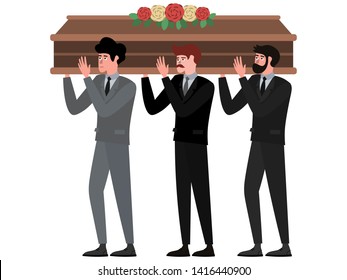
The carrying of coffin to a place of burial or cremation has been occurring for thousands of years, from ancient Egyptians, through to medieval Europe, across the Atlantic to the America’s during the civil war, treatment and respect for the dead in coffins, has always been upheld, unfortunately history has taught us that, as we delve back in our past it was only the wealthy and important people that were given funeral’s as we see today, for the poor member’s of society they were never afforded the same privilege’s, and never had the respect they thoroughly deserved at their time of death.
When Did Coffin’s Start Being Used?
The first coffins were used in ancient Egypt and were made from simple materials like wood or reeds. The wealthy would often have their coffins made out of more expensive materials like gold or silver. In the Middle Ages, coffins became more ornate and were often decorated with religious symbols. Today, coffins are still used to bury the dead, but they are much less ornate and are usually made out of wood or metal. (Depending on local laws)
The term coffin is derived from the Old French “cofin” and the Latin “cophinus“, which translates as “basket.” Ancient Egypt mummified bodies they were then buried in pyramids in sarcophagi prior to burial, and the coffins have served as tombs ever since. A casket is defined by Merriam-Webster as an “expensive luxury coffin.” In 1885, General Ulysses S. Grant was laid to rest in New York City in an iron casket made of iron. When the company folded in 1888, Forbes and his family reorganized it, changed the name, and continued to make metallic burial cases. In the present, stainless steel caskets are the most popular. One casket made of veneered wood is less expensive than one made from solid wood. There are now a variety of shapes for coffins and caskets, including musical instruments, automobiles, and wine bottles.
Brief History of The Coffin
Stone Age burials
Neanderthals living in Eurasia 600,000 years ago buried their dead in shallow graves with a few personal mementos such as tools. These burials were very simple and usually served as a way to deter scavengers. Recent discoveries show later Neanderthals performed ancient burial rites. A 50,000-year-old skeleton discovered in a cave in France has lead scientists to believe that people would ceremoniously bury their dead even as far back as the Stone Age. Some Neanderthals decorated themselves with homemade jewellery consisting of various pigments, feathers and shells.
Ancient Egyptians
The Egyptians were experts at mummifying everything, from humans to crocodiles. They held a strong belief that death was merely an obstacle to the afterlife and they preserved the body so the spirit of “Ka” could guide them to paradise. Apart from the heart, which was required for the Hall of Judgement, all organs were taken out and the body was embalmed and wrapped in linen. Much like today, there were a variety of ‘mummification packages’ so that everyone from the very wealthy to the underprivileged could mummify their loved ones and ensure they had a safe journey to the afterlife.
Medieval coffin making
We’ll never know how popular wooden coffins were during Medieval times due to the simple fact that most of them have disintegrated. Coffins made of lead and stone were reserved for the very wealthy or very important. The shape of these varied wildly from today’s coffins; they were a rectangular-shaped alcove carved into stone, with a rounded circle at the top for the head – the perfect shape for a person. An example of this can be found in the Greyfriars graveyard in Leicester, where Richard III was discovered. The lead coffin encased by a larger stone coffin contained the body of an old woman, who was said to be an important benefactor of Greyfriars between the 1200s and 1400s.
American Civil War
Although the French were the first to coin the term ‘coffin’, taken from the Greek term for ‘basket,’ it wasn’t until the American Civil War began in 1861 that coffins were widely used. Using them to transport dead soldiers safely and securely, Americans started to mass produce the coffin we know today. American Civil War coffins were commonly created from old wooden furniture as they were needed. The original coffins soon simplified into ‘caskets’ – the difference being that coffins have six sides and caskets have four sides.
Victorian coffins
The first coffin factory museum opened recently in Birmingham. Formerly one of Britain’s most famous coffin makers, the Newman Brothers Coffin Furniture Factory catered for the Victorians’ ‘obsession’ with death. In the Victorian era, funerals were a huge event and people would spend a lot of money on the event – including trimmings such as brass handles, burial shrouds, breastplates and grave ornaments. Burial vaults were particularly popular and the coffins destined for the vaults consisted of three layers – one of which was lead. It wasn’t uncommon for these coffins to weigh up to a quarter of a tonne.
Importance of carrying a coffin
To be part of a pall bearing team is an amazing honor, a chance to carry your loved one, your friend, colleague etc. A special dignified moment can give a real sense of belonging, and interaction within the funeral proceedings, it can help with closure as well as giving a sense of achievement to the individual performing the carry, when carrying the coffin you are very close to the person you have lost, and the ability to be able to do this lasting thing will not only stay with you forever but also for the families its a great sense of pride as well as closeness, bringing people together, it can help heal rifts and animosity as for those brief moments family and friends are carrying a sense of being a team resonates through all in attendance. Across time coffins and caskets have been carried by mourners as we look back in the past being chosen to carry a coffin, was indeed a massive honor and privilege, bearer’s would sometimes practice for days and days to get it right, as back in day’s gone by a funeral was a very public event, communities would be out to offer condolences and respect to the person who has passed away. If families weren’t able to carry then the members of the funeral party would take over this most cherished of roles, this has continued to present day with trained pall bearer’s provided by the funeral homes always ready, to step in and carry the coffin. But over the past few years I’ve noticed as a Funeral Director a shift in current trends, less coffin’s are being carried by families, friends aren’t as forthcoming to offer their shoulder to carry the coffin into church or chapel, even moving to funeral home staff, there is a distinct move from the willingness to carry a coffin, always looking at weights and the health and safety aspect of a carry? I want to delve in with some question’s which I will answer from my own personal opinion but always ready to receive feedback or indeed your own reflections or thoughts on this topic?
Why I Think Carrying is Important
I’ll give my answer here in two parts, I’ll answer as somebody who has lost someone very close to me and how carrying made me feel, also as a funeral professional and how carrying matters to me. As somebody who has lost family & friends who were very close to me, the ability to be able to carry a coffin from a personal perspective is immense, an absolute honor to be able, to lift a love one or friend on their final journey, to be able to have them so close to me, feels right knowing where my head is by the coffin, is next to their head, an endearing closeness, a single last act of love, respect, tradition, and dignity. For me for the people close to me I have lost I needed to carry the coffin, as it gave me an element of closure, a last chance to do something for them, something meaningful, something deeply sincere, something that will leave a lasting memory to cherish knowing I did something for my loved one or my friend, keeping a bond, a promise.
Secondly looking at it as an outsider looking in, why would you want complete strangers carrying your friend or loved one? Granted the funeral teams know what they are doing, as a funeral director I carry coffins as part of my role, but it does not carry the same weight or meaning as family & friends, fully understand that society is changing people are more relaxed around bereavment and are more accepting of what needs to be done, people are getting heavier this sadly is fact, this can be a massive consideration for a bereaved family, fear of being unable to carry their loved one? Or the added anxiety of the possibility of dropping the coffin? Also location is proving to be hurdle difficult to climb, based on the unbelievable health & safety protocols being pushed at the funeral sector. Overall I feel more negatives than positives are inflicted on families when deciding whether or not to carry a coffin, always remember there are fully trained staff on hand to advise and guide you every step of the way, if a funeral director feels that the coffin is beyond the weight safe for carrying or the distance/location is simply to difficult, we will come up with sutible safe alternatives, to enable a family the opportunity to take their loved one to their final resting place.
In Conclusion
If you want to carry speak to your funeral director to understand what options there are, and what mitigating factors maybe evident? Remember you only get one chance to do this, no re runs! no opportunities to try again, if you feel you want to carry a coffin please don’t be put off be inner fears speak to your family, talk to the Funeral Director, and think what your loved one would want you to do? As a bearer on a funeral for a loved one or friend you will get an unbelieveable feeling of inclusion to the final proceedings, you are doing something positive in that very dignified final act. Embrace it, consider it and do what your heart feels.
 Life Through Ordinary Eyes